

Depression 101: How Not to Wreck Your Mood
You’ve beaten depression—for now.
For months, you’ve felt well, working hard, thriving every day. But lately, your mental health has turned. You’re moody, depressed. At times, you’ve contemplated suicide. Now, you realize your choices haven’t been productive.
In fact, after drinking for nights, you’ve accepted the truth. You're hurting yourself, withdrawing from friends, missing out on sleep, hating yourself, sitting alone in the dark after the party’s ended. You’ve lost control, so you check in with your doctor. A medication adjustment helps, but you’re worried.
What if you relapse again?
If that’s you, understand that you’re not alone. Research shows that people who engage in self-destructive behaviors, particularly self-harm, are experts in their own suffering. But they’re also more likely to return to a psychiatric facility. And they may face repetitive visits if they continue the same behavior.
While self-harm isn’t the only self-destructive behavior, the evidence shows that undermining your recovery will prove disastrous—no matter what approach you take.
Still, mistakes happen. You’ll want to correct these behaviors. Doing so accounts for change, which will help you build resilience. Change begins with realizing that after falling, it's natural to return to your full height. To rebound stronger, more knowledgeable, and more equipped with lived experience.
The learning process begins once you’ve accepted a hard fact—self-awareness is the precursor to pleasantness, while acknowledging you’re on the wrong path is key to living with depression.
Keep reading to learn what mistakes to avoid so your mood remains stable, and what steps to take to stop behaviors that are only doing you harm.
Depression woes—the critical mistakes to avoid
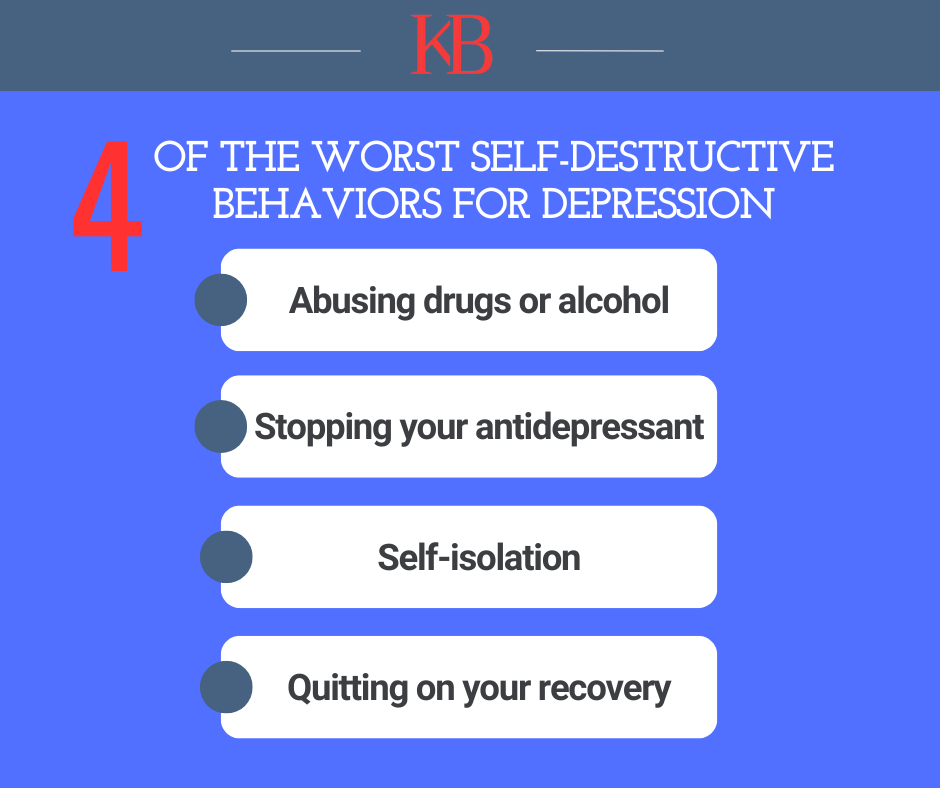
To manage depression, self-destructive behaviors must stop. These actions include deliberate, intentional acts of harm that leave you mentally or physically at risk, and more inadvertently concealed actions that gradually bring you down. Drug abuse, social withdrawal, and lashing out at others represent such behaviors. Others include self-blame, rumination, and binge eating—anything that hurts you, your mood, or your chances of achieving remission.
- Identify the behaviors that caused your symptoms
- Explore the reasons why you chose the behaviors
- Identify what steps will correct the behavior
- Apply those steps and change your behavior
- Reflect on your progress to live well with depression
Now, you’re ready. With these steps, you can change the behaviors mentioned in this guide. You’ll learn what’s driving your reasoning, whether that’s loneliness, boredom, or low self-esteem. You’ll apply steps towards changing behaviors. These steps may involve associating rewards with positive behaviors or removing triggers from your environment that cause you to harm yourself.
Finally, you’ll reflect on your journey of change. Have you learned from your mistake? If so, how? How can you be sure to not make the same errors in judgment?
With this information in mind, you’re ready to learn what not to do, so you don’t cause your mood levels to drop unexpectedly.
Don’t stop taking your antidepressant
For depression recovery, nothing is worse than quitting on your antidepressant overnight. The first problem you’ll notice is anti-depressant discontinuation syndrome (ADS). This condition causes flu-like symptoms, as well as problems with balance, coordination, and concentration.
Additional symptoms that arise with ADS include depression, increased suicidal ideation, electric shock-like zaps that occur in your brain, and irregular sleep patterns, both sleeping too much, and not enough.
This serious condition occurs due to the state of withdrawal your body enters. To avoid it, try slowly tapering for over four weeks with the support of a psychologist. Research shows that this is the best way to stop antidepressants.
Don’t live in the dark
The dark is not a great place to be if you have Major Depressive Disorder. Every fall, darkness disrupts your body’s circadian rhythm. The process cuts your energy tank in half, causing fatigue and worsening depression. Should darkness persist, bed confinement is a risk. The absence of light creates an inner turmoil of dark, depressing thoughts, which intensify due to lower levels of serotonin associated with near pitch black.
On the contrary, sunlight is a friend of depression, especially when shining directly on you or illuminating the surface of your desk. Try opening your curtains in the afternoons or checking into light therapy lamps. If not, know that excessive darkness will trap you in a sleepy, melancholy state, which is still a breakable nightmare when you invite in a vast amount of brightness.
Don’t skip therapy appointments
Psychotherapy functions on consistency—showing up, week after week, sharing, being vulnerable, and learning to manage and solve problems.
But if you start skipping sessions, you’ll see your depression spiral out of control. You might see symptoms return, have depressive thoughts that stay, or experience difficulties in daily functioning, issues which become more obvious the more appointments you miss.
Eventually, skipped sessions may result in relapse or hospitalization, and even that’s a slow, painful process you'll want to avoid.
Such outcomes are avoidable because success in therapy depends on dedication—a steady, continuous effort. Without it, you’re unable to make meaningful progress. So, whether you’re low on fumes or feel like your head will explode from all the brainwork, it’s important to brainstorm solutions for scenarios involving you missing your appointments.
Here some tips that will help:
- Reschedule for the near future
- Ask to go easy during sessions
- Change the times of appointments
- Do some of the work at home
- Make sure you’re rested and fed
- Choose a closer therapist
Anything but skip those appointments—you deserve them. And your mental health deserves a bit of prioritization.
Psychotherapy functions on consistency—showing up, week after week, sharing, being vulnerable, and learning to manage and solve problems.
Don’t abuse drugs or alcohol
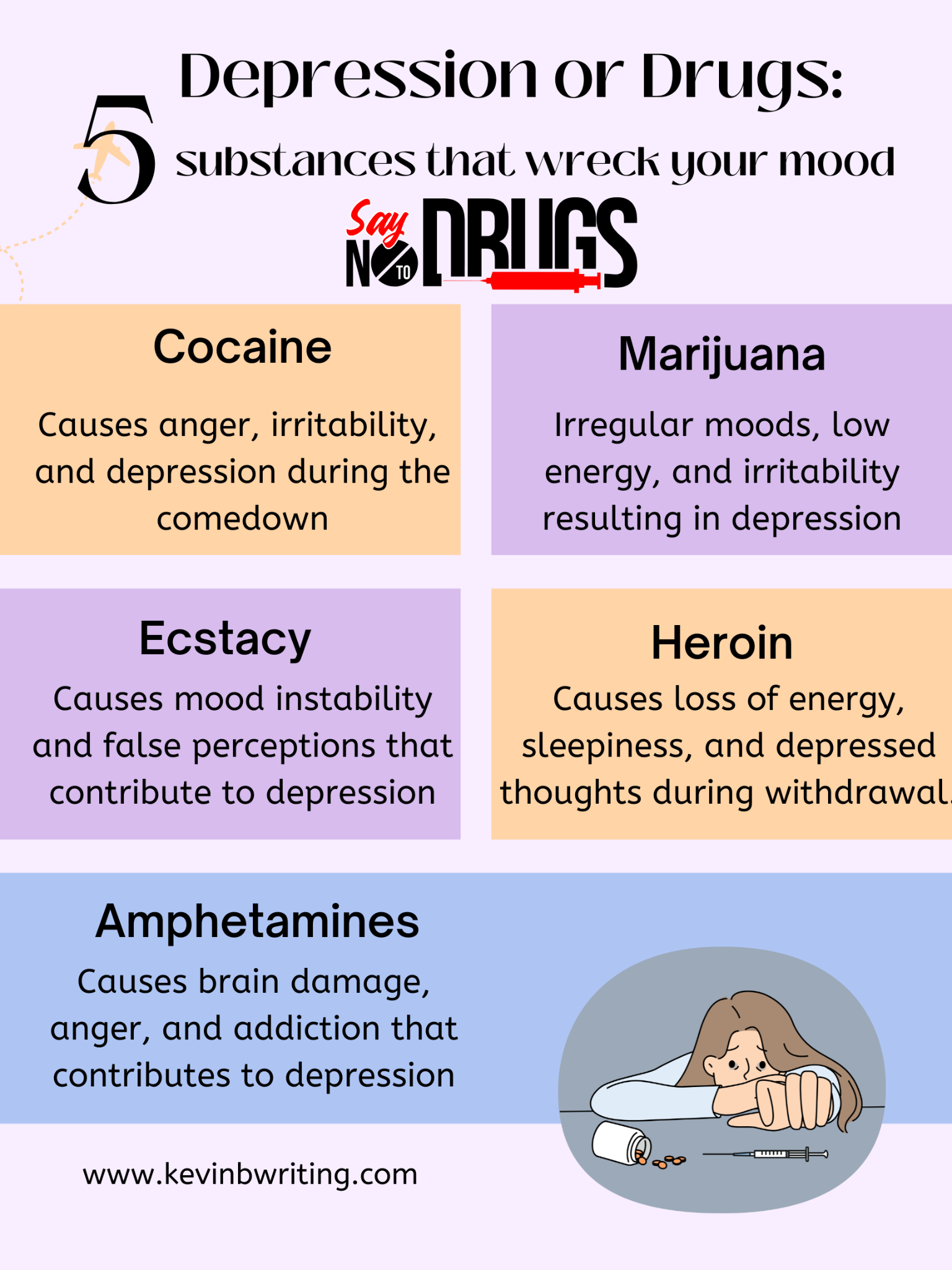
Alcohol is a depressant. It slows down your heart, clogs up your thinking, and drops your mood, even if you’re having a great time.
People with MDD should always avoid drinking alcohol. Women, especially, are at risk, as studies show that around seven drinks—and possibly before, women are likely to feel depressed.
Other drugs cause depression also:
- Cocaine: an intense rush first, followed by a depressed comedown.
- Ecstasy: euphoria and mood instability, with depression being common
- Heroin: extreme sedating effects that lead to addiction and depression
- Marijuana: irregular moods with psychosis, both of which cause depression
- Amphetamines: cause brain damage and lead to depression
No recreational drug is safe. Not without a psychiatrist's guidance. Avoid substances at all costs to avoid a poor mood.
Don’t self-isolate
Social isolation is a deathtrap. With no contact, your chances of escaping gloom are hopelessly compromised. The loss occurs because isolation is an inhibitor to brain stimulation, meaning staying indoors stops your brain from working productively, leaving your mind foggy and slow, and your mood dreary and depressed.
To beat this risk, venture outdoors, go for walks, or try window shopping for a warmer, socially stimulating experience. Simply having the option to pursue social engagement works wonders when you’re begging for companionship.
Social isolation is a deathtrap. With no contact, your chances of escaping gloom are hopelessly compromised.
Feeling stuck? Not all social isolation must end in detachment. Opting for video conferencing or online multiplayer games can ease the pain of loneliness and encourage you to engage with others.
Most importantly, it’s important to be receptive. Opportunities for socialization can arise any time.
Managing depression—behaviors you must stop
While some behaviors must be avoided, others you may have already started, possibly, to cope with depression.
Unhealthy coping is typical among people with depression. When medications or treatment prove less effective, it’s common to resort to risky, high-reward behaviors.
Such behaviors usually take redirecting to correct. You can change independently by learning to be aware of these behaviors’ effects.
Stop eating unhealthily
Junk food, binge eating, and skipping meals are linked to depression. Many food preferences exist that you’ll want to skip or consume minimally, including sugary foods, like soda and candy, processed foods, like chips and frozen dinners, and saturated foods, like butter and excessive amounts of cheese.
Ultimately, eating unhealthily is a risk factor for mood instability—mostly downs followed by ups that are really just normal. Try healthy snacks, like dried fruits, nuts, and whole wheat breads. These ingredients are better for your brain and body.
Stop comparing yourself to others
Today, plenty of ways exist to compare yourself to others—they're all problematic. Social media comparisons can trap you in rumination for hours. Adult sibling rivalry can have you feeling bad all day because you’ll see admirable traits in your siblings you wish you could replicate. No matter how depressed you are, comparing yourself to others will leave you sadder, angrier, and more hopeless than ever.
The drop in your mood occurs to negative thoughts caused by depression. These thoughts intensify when you see other people’s characteristics, especially if they make you feel inadequate. The better choice is to let go of needing to be better than others. Write self-affirmations—statements that affirm your positive traits. Or focus on activities that involve you using your strengths.
Learn to feel proud of your unique personality. You’ll maintain a much more pleasant mood when you do.
Stop associating with toxic people
People who make you feel bad will wreck your mood. They’ll make you question your values, criticize yourself, and teach you to blame others. Making matters worse is the fact that these individuals enjoy getting you down, causing you to turn resentment inward for your inability to take a stand.
Associating with negative crowds is a horrible mistake to make with depression. In many ways, you’re self-destructing by copying their actions, compromising your values, or behaving in ways that are detrimental to your recovery. To improve your mood, spend time with positive, uplifting people. These are people who are supportive and will share time with you in a way that’s rewarding.

Stop blaming yourself
For depression, self-blame is a common response. It’s characterized by irrational beliefs that depression is your fault, and painful memories of possibly worsening your depression.
But self-blame is misplaced. Depression isn’t your fault, but MDD causes you to direct energy towards self-criticism.
But there is nothing life-ending about making mistakes. Instead of self-blame, choose self-compassion. Being compassionate to yourself means practicing self-care when your thoughts spiral to negativity. You might relax, have a bath, watch your favorite movie, or have ice cream. The idea is to respond to a depressed mood with kindness, not self-blame.
Stop quitting on your recovery
There is research to not giving up on the idea of living well with depression. Recently, a study of treatment outcomes shows 54% of people improve after taking antidepressants, while 62% improve after psychotherapy. Therapy and medication are the top treatments for depression. If you’re engaged, taking your meds, and trying your best, there are great chances that you’ll enter remission.
Another interesting finding: 54% of young people see a reduction in symptoms within a year—and that’s without treatment. And with the use of cognitive behavioral therapy, 58% of older adults see long-term remission—up to 10 years. These numbers reflect the hope that there is for receiving treatment, while demonstrating the fallout that can occur should you give up on your recovery.
If you’re exhausted, instead of giving up, ask questions that will push you to keep trying:
- How much progress have I made?
- How much will I lose if I quit?
- What can I do now to make life better?
- What can I say to my psychiatrist to get help?
- Are there any additional mental health services that will help?
No matter what you do, don’t give up. Depression is a manageable condition, and more people are living better lives every day.
If you’re engaged, taking your meds, and trying your best, there are great chances that you’ll enter remission.
Stop ignoring exercise
Physical exertion helps with depression, while sitting on a couch is sure to result in more severe depression. Exercise gets your blood flowing, your heart rate up, and oxygen moving through your brain. Exercise is a key factor in creating dopamine releasee, which is critical to maintaining an optimal mood.
If you want depression to stay away, stop spending weeks without exercise.
If ignoring exercise is a mistake you make often, you’ll benefit from exploring your reasons for resistance. If low energy is the cause, understand that even moderate amounts of exercise, as seen with stretching or yoga, are helpful. If motivation is an issue, try starting small with daily increments—say 15 minutes for starters. Building the habit of getting your body moving will help you avoid the mistake of going for long periods without exercise.
Stop ignoring symptoms
If you’re feeling a little sadder than usual, or if suicidal thoughts have returned after months of being gone, ignoring symptoms won’t only wreck your mood, it’ll jeopardize your safety and put you at risk for hospitalization.
The best choice instead is to communicate your symptoms quickly with your psychiatrist. Don't ignore symptoms. Early intervention stops your mood from dropping to dangerously low levels.
Stop watching violent media
Media featuring gore and depravity might look exciting but will still negatively affect your mood.
For example, research shows wartime media exposure increases depressive symptoms and results in heightened levels of stress. Study respondents were also found to experience greater difficulty sleeping. The insomnia is a result of vivid dreams, nightmares, and late-night stress that occurs from watching violent media throughout the day.
If you think of action portrayed in violent media, you’ll understand its significance. From fiery, high-speed chases to viciously brutal fights, the crime and victimization on display in today’s media prevents depressed folks from feeling their best.
Among the mood changes you’ll notice are anger and sadness, which occur due to the exposure of violence, and feelings of guilt or shame, which occur because of the glamorization of victimization.
Instead of having these films on your TV, opt for humor, casual adventure, family films, and musicals. Relaxed, fun forms of media are ideal for laughs, perfect for socialization, and helpful for alleviating depression.
Stop using screens too much
Staring at screens all day isn’t only bad for eye health, it worsens your mood, leaving you feeling a little more irritated due to the influx of mindless information entering your brain.
Doomscrolling, especially, takes poor depression management to new levels. Gazing at a screen, surfing the Web, barely stimulates your brain, leaving you with low energy, lack of motivation, and depression symptoms that occur because of inaction.
It all comes down to activity. The brain needs a combination of creativity, challenges, stimulation, and relaxation. Keeping your eyes fixed on a screen will lull you into a dull state of unfocus, while constantly moving your eyes will prevent your brain from resting.
By taking a break every 20 minutes, walking away from your device, or replacing screen time with exercise, you’ll venture into the world of human engagement, resulting in positive, open-minded thinking that’s perfect for a well-balanced mood.
Stop ruminating on negativity
With depression, your thoughts may lean towards the negative. That’s a problem; your thoughts should be positive. You should feel level-minded and calm. But you may find yourself ruminating, constantly thinking of a tragic past. Or you may dwell on negative ideas or thought processes that keep you stuck in a bad mood. This kind of thinking is the worst way to manage depression. You’ll feel sadder, angrier, and without direction if you ruminate on negativity.
Your goal should be to learn to challenge these thoughts. Taking the right steps will place you in a proactive position, so you actively challenge negativity rather than be a mere passive observer.
Take this three-step process:
- Stop—distract yourself with a constructive activity
- Brainstorm solutions to problems
- Replace negative thoughts with positive thought
This quick process takes time to develop. The first challenge is stopping yourself. A full stop in negative thoughts might require you to get up and switch rooms. Brainstorming solutions may mean journaling to address the problem on which you’re ruminating. Replacing the thoughts isn’t easy but can be done independently. To replace negativity with positivity, develop a catch phrase you can recite in place of a negative thought.
You might remind yourself of how far you’ve come. Or you might recall the benefits of the antidepressant you’re taking. As long as you’re not simply dwelling on negativity—but taking steps to redirect—you'll find that your mood remains stable, and depression symptoms remain at bay.
Depression 101: Tips for stopping self-destructive behaviors
Stopping self-destructive behaviors takes practice. But you won’t want to continue making these mistakes if you’re living with depression. The trick is to learn to confront negative thoughts, redirect negativity, and learn to live a recovery lifestyle that supports a healthy life with depression.
To avoid an unfortunate hit to your mood, remember these tips for stopping self-destructive behaviors:
- Think of long-term disadvantages
- Ask for feedback on your life choices
- Address underlying causes in therapy
- Build a healthy support network
- Take one step forward in your recovery a week
- Explore support groups and forums
- Make your day commitment meaningful
With time, your symptoms will improve.
If your mood has worsened due to mistakes in behavior, understand that confronting your actions is key to successful depression management.
Recap
Depression is one of the most serious conditions in the world. People who are depressed feel sad most of the time. They may have recurring suicidal thoughts or feel depleted of energy. Fighting these symptoms begins with adopting a recovery lifestyle that’s conducive to healthy living and thinking.
At times, you may feel compelled to move backwards. You might think there are benefits to reckless or self-destructive behaviors. Understand the long-term disadvantages of these mistakes to ensure you remain in a positive frame of mind.
The more effort you put into living well with depression, the greater your chances of staying in remission.
Kevin Brown writes on mental health. For more great stories, connect with Kevin on X at @kevinbwriting.
0 Comments Add a Comment?